
July 29, 2026


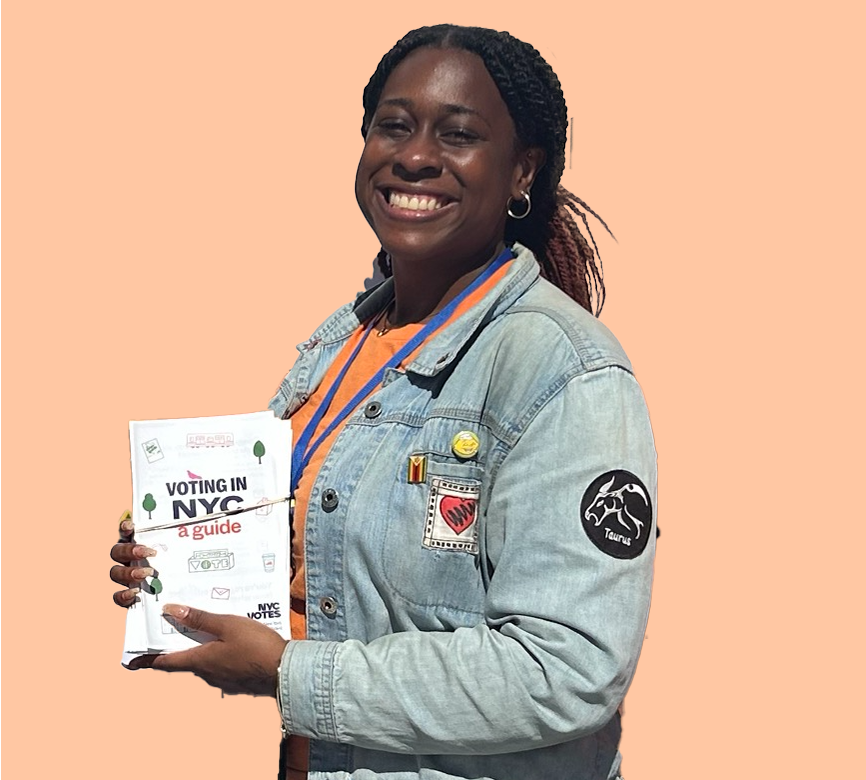
Amanda Martin-Lawrence, People Strategy Program Manager, grounds her work in one simple belief: people do their best when they feel valued, respected, and seen.
Amanda learned early on how culture, identity, and community influence the way people experience the world. Today, she brings those experiences to her work at the New York City Campaign Finance Board (CFB), where she supports workplace culture, employee engagement, and connections between the agency and the communities it serves.
"Community and people are very important to me," Amanda shared in her conversation with us.
That connection to people has informed Amanda's path throughout her career, from education equity work to her current role helping CFB employees and New Yorkers feel supported and included.

Amanda Martin-Lawrence tabling for NYC Votes at the 2025 Disability Pride festival alongside staff.
Representation Starts at Home
Amanda's connection to equity began with her own experiences navigating different cultural communities at home.
Growing up in Brooklyn as a first-generation Jamaican American, with family ties to both Jamaica and England, Amanda's upbringing was shaped by her experiences moving between different cultures and environments. It gave her an early understanding of how people's backgrounds influence the way they see themselves and the world around them.
Education was a guiding principle in her Caribbean household and became the first place where Amanda saw the impact of opportunity. After attending Title I schools, public schools that receive federal funding because they serve many students from low-income families, she noticed how resources and circumstances could define the experiences students had access to.
While still in high school, she wrote a grant that funded overnight college visits for younger students, giving them the chance to imagine themselves in spaces that they may not have previously considered.
The work reflected something Amanda continues to carry into her role today: creating opportunities begins with understanding who people are and what experiences guide them.
From Crown Heights to the World
In Crown Heights, she was surrounded by Caribbean cultures, languages, and traditions that reflected her family's background.
Those familiar connections existed alongside the experience of moving through spaces where she was confronted by unfamiliar experiences as well.
"Growing up in America as one culture, but your family's culture is from someplace else, I do think you experience the world in a very different way," she said.
Growing up in America as one culture, but your family's culture is from someplace else, I do think you experience the world in a very different way.
True access is not only having resources available, but also about whether they feel comfortable entering places and participating once they are there.
"I think being a first-generation American has definitely shifted my understanding of access and inclusion," Amanda said. "Not just people [who] have physical or health-related needs, but also thinking about, culturally, what does it mean for people to have access to resources? What does it mean for people to have access to space and feel as though they belong in those spaces?"
At the CFB, Amanda brings that approach into the way she develops employee programming. Rather than assumiing what people need, she creates opportunities for staff to share their own experiences and build the spaces around them.
"It's giving our staff the space to say, 'Hey, this is something that would make me feel seen,'" she said.
Creating Resources That Inspire
Amanda's work with Employee Resource Groups (ERGs) reflects her belief that connection grows when people have opportunities to share their experiences.
She co-leads Trailblazers, an ERG for employees with different first-generation experiences. The group is intentionally open to first-generation Americans, first-generation college graduates, and others navigating new institutions.
Beyond ERGs, Amanda supports "Lunch and Learn" events, cultural celebrations, and other staff programs designed to encourage conversation and learning across the agency.
Creating these moments is not only about sharing information, it's also about allowing colleagues to connect with one another in ways that may not happen during a typical workday.
"I think it's very important for you to still feel joy when you're [at work]," Amanda said. "I feel like that's where you see people really strengthen those connections that they have with each other as people."
I think it's very important for you to still feel joy when you're [at work]. I feel like that's where you see people really strengthen those connections that they have with each other as people.

Amanda Martin-Lawrence with NYC Votes staff at the 2025 African American Day Parade Health, Literacy, and Education festival.
The Civic Connection
Amanda carries the same people-centered approach into her perspective on civic engagement.
For public agencies, nurturing trust with communities requires more than providing information. It requires being present, listening, and creating opportunities for residents to share what they need.
"I think oftentimes it's easy for people to say that they care about a cause, but you've never been in the community, you've never met the people," Amanda said. "In making yourself physically present, people see you, and they have more trust."
Through events like the Disability Unite Festival, NYC Votes staff connect directly with New Yorkers, answer questions about voting, and learn more about the experiences that influence how people participate in democracy.
Those conversations allow the agency to better understand community needs and identify ways to make civic engagement more accessible.
The Impact of the Work
For Amanda, workplace culture is created through everyday moments that allow people to show up as themselves.
"It means feeling safe to eat Jamaican salt fish in the office if I want to bring that for lunch," Amanda said. "It means feeling comfortable to wear box braids. It means being comfortable to wear my acrylic nails."
It means feeling safe to eat Jamaican salt fish in the office if I want to bring that for lunch. It means feeling comfortable to wear box braids. It means being comfortable to wear my acrylic nails.
These examples may seem simple, but they represent something larger: having the freedom to share parts of yourself without feeling like you need to change who you are to fit into a narrow standard of who you should be
"[It's] showing up and not feeling as though I have to shrink in any way," she said.
Creating that kind of environment matters because employees bring those experiences into the work they do every day.
"If you love where you work and you feel seen," Amanda said, "that pride is reflected in how you show up."
How To Be a Better Ally
When it comes to being a better ally, Amanda keeps her advice simple.
"Treat people like people."
For her, that means approaching others' experiences with curiosity, asking questions instead of making assumptions, and respecting people's autonomy.
Looking ahead, Amanda hopes to continue creating opportunities for employees to connect through shared moments that bring people together.
"I want to bring back fun in the workplace," Amanda said. "I want to create more opportunities for staff to engage together, to laugh together, to get to know one another."
At the center of Amanda's work is a message she hopes people carry with them:
"We all have a right to be here."
We all have a right to be here.
That belief connects the different parts of Amanda's role. From supporting employees at the CFB to engaging with New Yorkers and helping create spaces where people feel seen.

Amanda Martin-Lawrence and colleagues tabling for NYC Votes at the 2025 Disability Pride festival.