
August 27, 2026


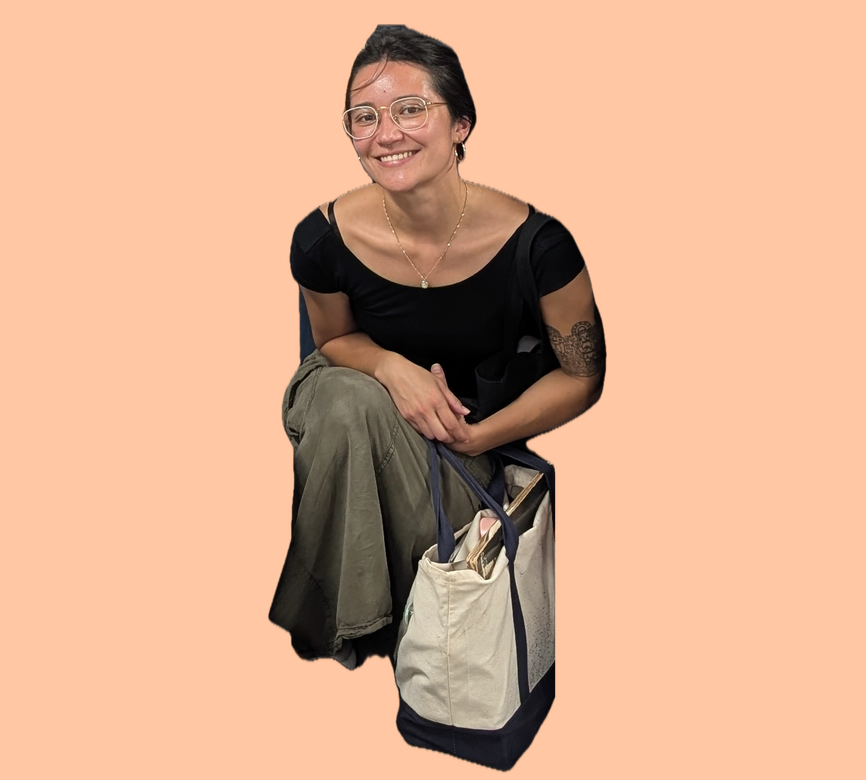
When María Fernanda Buitrago moved from Bogotá, Colombia, to New York City at 14, learning how to navigate her new home required more than learning English.
It meant learning a new school system, explaining unfamiliar terms from school to her family, and figuring out how public institutions worked.
Years later, those experiences shape how María approaches her role as Youth Programs Coordinator at NYC Votes. She helps lead the NYC Votes Youth Ambassador program, where New Yorkers ages 14 to 18 learn about voting, local government, community outreach, and the many ways they can participate in civic life.
But María does not view herself as someone who enters the room with all the answers. This was her first Youth Ambassador cohort, and she joined the program ready to learn alongside them.
"Teaching is another form of learning," she said. "You teach me something, and I teach you something... we are both taking something in."

María using her green thumb with youth at East New York Farm.
From Bogotá to the Bronx
As she and her family became acclimated to their new home, they settled in the Bronx.
"The Bronx is very, very special to my heart," she said.
María learned English in school while her mother faced the challenge of rebuilding her life and career in a new country. Her mother had been a nurse in Colombia and was the first person in her family to attend college. But it was hard to pursue that same path in a new country while learning a new language and the complexities of a new life.
Watching her mother encounter those barriers gave María an early understanding of how difficult it can be to enter systems when other obstacles are in the way.
María faced her own version of that challenge at school. She had to learn the language of the education system and then explain it at home.
"There was the English barrier, but there was also the language of the school system itself," she said. "I was explaining to my immigrant mom what an AP class was and why it was important."
She recognizes that experience in some of the Youth Ambassadors she works with today. Young people in immigrant families may translate words, but they often translate much more than language. They explain school requirements, government processes, and cultural expectations to the people around them.
That responsibility can be difficult, but María has also seen young people turn it into a powerful skill.
At voter outreach events, Youth Ambassadors who speak languages including Mandarin and Spanish have used those skills to connect with members of their communities. María has watched a conversation change as soon as someone hears a familiar greeting in their own language.
"Suddenly, that cultural translation you are doing at home has this amazing outlet," she said. "You can explain to someone in your own culture and language why voting matters or how the system works."
There was the English barrier, but there was also the language of the school system itself.
During María's path to U.S. citizenship, she and her family had to learn how different systems worked and where they could turn for support.
"I navigated a lot of those barriers with my mom and my family," she said. "We were learning how systems work, how you can participate, and how you can get support if you need help with housing or food."
Those experiences helped her see education as a form of access.
Before joining NYC Votes, María worked as a community educator at the Violence Intervention Program, a nonprofit serving survivors of domestic violence in New York City's Latino Community.
As part of that work, María led workshops for teenagers, including immigrant youth. She found them energetic, curious, and constantly surprising. But she wanted the chance to build deeper relationships and understand what youth really needed.
The Youth Ambassador program offered that opportunity.
"We really get to know each of the kids and understand their interests," María said. "We can learn what they want to work on professionally and academically. It is a different kind of relationship."

María with the Ambassadors at Los Herederos Radio Station in the 74st Jackson Heights subway, located in one of our priority neighborhoods.
Growing With the Cohort
When María stepped into her first program cycle this year, she entered an established program while also helping introduce new ideas. She learned from experienced colleagues, returning program alumni, and the ambassadors themselves.
"I have been learning alongside them and going through the whole experience," she said. "But I am still learning."
That shared first-time experience became one of her strengths. As ambassadors encountered lessons, field trips, and public outreach for the first time, María was also observing the program with fresh eyes.
María's own education has taken place in classrooms, community organizations, cultural institutions, and throughout New York City. That mix of academic, cultural, and community learning influences how she sees the Youth Ambassador program. The city itself becomes part of the curriculum.
Ambassadors study moments in New York City history, learn how local government works, meet people working in public service and community organizations, and visit places such as the Museum of the City of New York, the Museum at Eldridge Street, and a community radio station in Jackson Heights.
At the Museum at Eldridge Street, María learned alongside the cohort as a guide connected Jewish, Puerto Rican, and Chinese immigration histories to the present.
"The city is their own learning center," María said. "It is not just saying that we have civic participation. It is showing them what that environment looks like."
The city is their own learning center. It is not just saying that we have civic participation. It is showing them what that environment of civic participation looks like.
Young people are often described as disconnected from politics. María's experiences with the Youth Ambassadors have shown her the opposite.
"They are paying attention and connecting things," she said. They are very interested. They may not have the same names or narratives that we have, but they see what is happening in their neighborhoods."
Government classes can explain how institutions work, but information alone does not always lead to participation. The Youth Ambassador program connects those lessons with local issues, public speaking, community outreach, and opportunities to be heard.

Registering voters during Primary Election Day in Jackson Heights
Finding Hope in Youth
When María thinks about the future of democracy in New York City, what gives her hope is not that young people already know everything. It is that they are eager to learn, act, and imagine something better.
"Their enthusiasm gives me hope," she said. "There is so much energy there that you cannot pretend there is no change. There is change. We just need to work for it."
María entered the Youth Ambassador program to help young people understand their city and their role in it. Her first cohort has also helped her see her own role too.
Alongside a cohort finding its civic voice for the first time, María is discovering what becomes possible when everyone in the room is allowed to be curious.
There is so much energy there that you cannot pretend there is no change. There is change. We just need to work for it.

The 2026 Youth Ambassadors walking towards the Museum of the City of New York.