
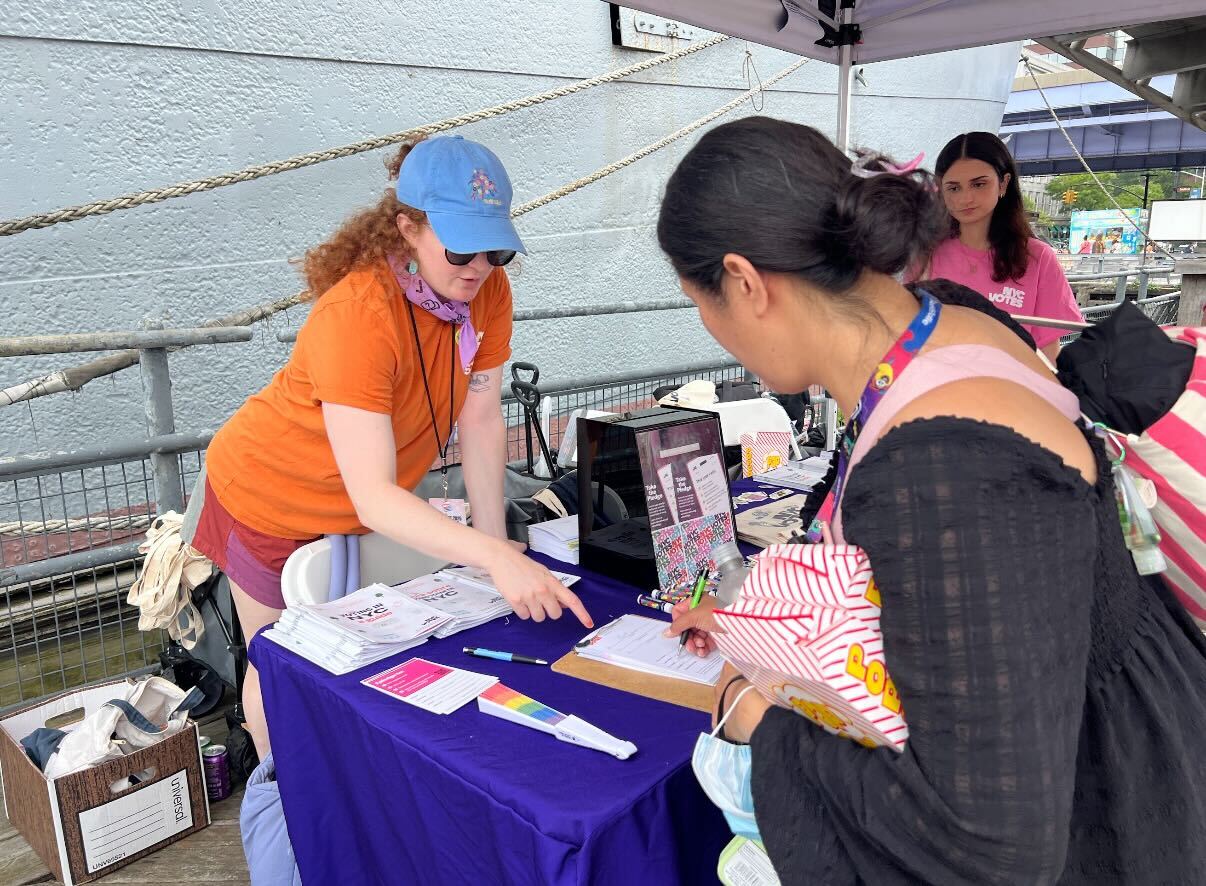
CFB Director of Public Relations Amy Lebowitz connecting with a potential voter at an NYC Votes registration event.
May 19, 2026


Millions of New Yorkers tuned into last year's citywide mayoral debates, an indication of the growing appetite voters have for access to unfiltered information. Audience members listened intently to hear candidates' stances on key issues impacting them. Their animated reactions ran the gamut in the auditorium at LaGuardia Community College's Performing Arts Center, the site of one of the debates, as the cameras rolled. When the debate ended, reporters scurried to the "spin room" in hopes of capturing a headline-making quote from the candidates and shaping the next big story. Within a week, voters filtered out the noise of the election to find their way to the polls. The world watched as NYC saw its highest turnout in over 50 years.
More participation is a sign of growing access to civic knowledge. That civic knowledge often comes straight from community members themselves, which is why NYC Votes works with partners to offer resources with the agency's messaging. As part of the Campaign Finance Board's (CFB) voter engagement efforts, Amy Lebowitz, the CFB's Director of Public Relations, leads the team helping to shape the agency's messaging. Lebowitz's investment in social and political news, plus her love of writing, led her to democracy work. With a wealth of communications experience, Lebowitz strategizes how to best discuss the agency's work, mission, and vision in a way that resonates with as many New Yorkers as possible. Lebowitz prioritizes thoughtfulness when communicating with the press and public, saying, "a goal of mine is to use our platform as a government agency to uplift the community partners who play such a big role in disseminating voter information to people who may have been underrepresented in the process or historically left out of voter engagement spaces."
More participation is a sign of growing access to civic knowledge. That civic knowledge often comes straight from community members themselves, which is why NYC Votes works with partners to offer resources with the agency's messaging.
NYC Votes partners with community organizations like the National Association of Latino Elected and Appointed Officials (NALEO) to reach Latino New Yorkers. NALEO, a nonpartisan organization, fact-checks the media landscape and informs voters of false information circulating before ballots are cast. To overcome linguistic and systemic barriers, organizations like NALEO address one of the many demographics with limited access to civic resources, whether at the polls or in-office. Collaborations like this one with community-based organizations and the press help to expand voters' access to accurate, nonpartisan information.
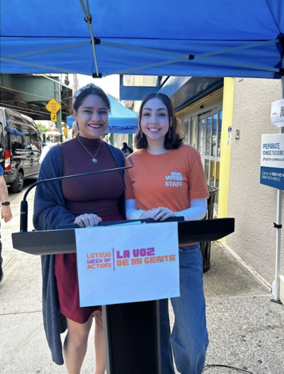 NYC Votes Assistant Press Secretary Jadel Munguia (right) with Youth Engagement Coordinator Jatnaa De La Cruz (left) at a Latino Day of Action event.
Effective communication starts with recognizing the real people on the receiving end. The Public Relations team works towards educating community organizations with precise messaging and collaborating with local newspapers on op-eds. The CFB's Assistant Press Secretary, Jadel Munguia, supports the team's management of NYC's vast press network to reach communities with lower voter turnout through the media. Munguia considers how the media impacts local demographics differently. In the Spanish-language article she authored for El Diario, Munguia led the agency's efforts to connect with voters, like some of her loved ones, who may feel disenfranchised. Her work is a continued navigation of moving beyond the jaded feelings and social-media discourse, to reach voters who may be more exposed to dis- and misinformation.
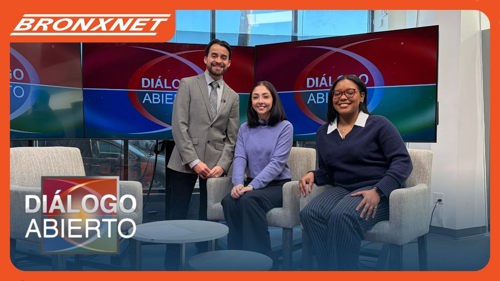
Assistant Press Secretary Jadel Mungia, alongside a CUNY Fellow and the host of Bronxnet's Spanish-language "Open Dialogue" news program.
While she notes that misinformation is unintentionally spread, Munguia defines disinformation as, "the intentional creation of false information that is crafted and disseminated to cause harm." She encourages voters to stay vigilant by independently researching issues of concern, while Lebowitz emphasizes turning to reputable sources with the most expertise, like nonpartisan government agencies.
According to a study at the University of Michigan, Americans avoid news and political discussions altogether due to misinformation in the media. Shunning the news and informational resources shuts everyday Americans out of the conversation. This distrust of the media impacts how many voters cast their ballots, if they even choose to vote. Lowered participation means that the government will only represent some Americans, which perpetuates the lack of trust.
Amidst the current media landscape, NYC Votes' nonpartisan voice — which prioritizes facts over bias, is more important than ever. Nonpartisanship, or the lack of political affiliation, differs from bipartisanship, which indicates the inclusion of at least two political parties. Taking into account every political affiliation in the media, a Brookings and YouGov study found that, "political partnership — and especially self-reported animosity towards the opposing party — strongly predicted fake news sharing." Munguia echoes the agency's stance on nonpartisanship, saying, "We just want everyone to vote. We don't care who you vote for."
In the spirit of transparency and accuracy in election data, after every election, the CFB releases a Voter Analysis Report (VAR) to measure voter registration and turnout, voting behavior of different communities and neighborhoods, and more. The VAR's findings inform the CFB's messaging, policy recommendations, and efforts to boost civic participation based on the data's findings. The 2025 VAR highlights the increased participation of voters under 30. In light of these and other findings, the agency's policy analysts recommend aligning the party enrollment and change of name/address deadlines with voter registration dates to minimize confusion.
Because politics and voting can get confusing, NYC Votes distributes translated voter guides, offers educational trainings and materials to local community partners, and even co-hosts the citywide debates with local outlets. Reflecting on her own work and that of her colleagues, Munguia says that, "we are bridging the gap between... complicated jargon and everyday New Yorkers... it's [our] job to make the connection and share the information in a truly accessible way."
Accessibility in this case means teaming up with the press to combat confusion with accuracy—whether about deadlines, voter eligibility, or how to vote. This shared responsibility is not taken lightly. Though the agency relies on the press to share this information, the press also has a duty to hold the government and candidates accountable. Keeping New Yorkers in the loop is a key part of civic engagement. Lebowitz agrees, "reading local news and paying attention to what's happening in your local community is a way of claiming power... learning about those things is a way to understand your place in the world and places you can have an impact."
Reading local news and paying attention to what's happening in your local community is a way of claiming power... learning about those things is a way to understand your place in the world and places you can have an impact.